

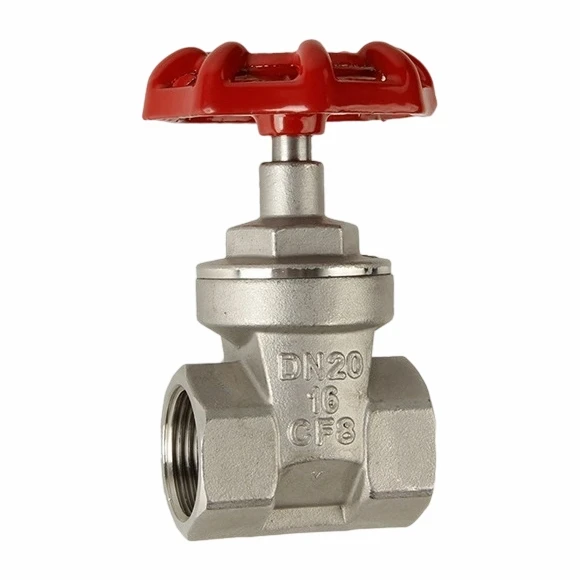
Stainless Steel Hard Seal Gate Valve
Soft-Seated vs. Metal-Seated Gate Valves: A Critical Industrial Choice
In industrial fluid systems, the sealing material between the gate and the seat determines not only the valve's leakage performance but also its service life under demanding conditions.
Soft-seated gate valves use polymeric materials (PTFE, Nylon, etc.) as the sealing surface. They offer bubble-tight shut-off at lower pressures and temperatures but degrade when exposed to:
- High temperatures (>120°C) – polymer softens and extrudes
- Abrasive media (slurries, sand) – polymer wears rapidly
- Steam or superheated water – polymer fails
- Corrosive chemicals – polymer attacked
Metal-seated gate valves (this model) use metallic sealing surfaces-stainless steel against stainless steel, or hard-faced alloys. They tolerate:
- Temperatures up to 425°C (depending on material)
- Abrasive particles in the flow stream
- Steam, superheated water, and thermal cycling
- Corrosive media (with appropriate alloy selection)
The trade-off: Metal-seated valves do not achieve the absolute zero-leakage (bubble-tight) shut-off of soft-seated valves under low pressure. But in high-temperature, high-pressure, or abrasive services-where soft seals would fail within weeks-the metal-seated valve continues to operate for years.
Yunnl stainless steel metal-seated gate valve is engineered for these demanding applications: steam, hot oil, corrosive chemicals, and abrasive slurries where reliability under extreme conditions is non-negotiable.
Product Overview
Yunnl stainless steel metal-seated gate valve provides reliable isolation for high-temperature, high-pressure, and corrosive industrial services. CF8/CF8M cast stainless steel body, hard-faced metal seating surfaces, rising-stem wedge gate design. Available DN15-DN50 with threaded, flanged, or socket-weld connections, PN16/Class 150 rating, operating up to 425°C. Sample support, 15-day delivery and flexible payment terms for global industrial distributors and engineering contractors.
Core Performance Advantages
-
High-Temperature Capability – Up to 425°C
The metal-to-metal sealing surfaces and all-stainless construction allow continuous operation at temperatures that would destroy polymer seals. This makes the valve suitable for steam lines, thermal oil systems, and high-temperature process fluids.
-
Abrasion & Erosion Resistance
Hard-faced seating surfaces resist wear from abrasive particles in the flow stream-sand, scale, catalyst fines, or other solids. In services where soft-seated valves would erode in months, this metal-seated valve continues to seal for years.
-
Corrosion Resistance – CF8/CF8M Alloys
The stainless steel body provides excellent resistance to oxidation and general corrosion. CF8M (316 equivalent) adds molybdenum for enhanced resistance to chloride pitting and crevice corrosion.
-
Low Maintenance Requirements
The metal seating surfaces require no replacement-they can be re-faced (ground) if worn. Packing replacement is the primary maintenance task, and with the rising stem back-seating feature, packing can be replaced while the valve is in service (fully open position).
-
Bi-Directional Shut-Off
The gate valve provides positive shut-off in both flow directions. The wedge gate seals against both upstream and downstream seats, making it suitable for applications where flow direction may reverse or where isolation is required regardless of flow orientation.
-
Full-Bore Flow (Reduced-Bore Option)
Full-bore gate valves provide zero flow restriction-the internal diameter matches the pipe diameter, with no pressure drop across the valve in the open position. This is critical for slurry services, pigged pipelines, and systems where pressure drop must be minimized.

| Feature | Description |
|
Place of origin |
China |
|
Brand name |
Yunnl |
|
Product Name |
Stainless Steel Hard Seal Gate Valve |
| Body Material | Stainless Steel |
| Sealing Type | Metal‑to‑metal (hard seal / metal‑seated) |
| End Connections | Flanged / Threaded (BSP/NPT) / Socket Weld |
| Pressure Rating | PN16 (1.6 MPa) / Class 150 |
| Operating Temperature | 5°C ~ 90°C |
| Applicable Medium | Steam, hot oil, corrosive chemicals, water, gas, slurries |
| Operation | Manual handwheel (rising stem) |
|
Size |
DN15-DN50 |
|
Minimum Order Quantity |
1 |
|
Price |
Negotiable |
|
Packing |
Yunnl standard packing |
|
Payment Terms |
L/C, D/A, D/P, T/T, Western Union,MoneyGram |
|
Delivery Time |
15 Days |
Working Principle: The Gate Movement Sequence
The gate valve operates by a linear motion mechanism:
Stem rotation to linear translation:
- The handwheel is fixed to the top of the stem (or connected via a stem nut in the yoke)
- Rotating the handwheel turns the stem threads
- The stem threads engage with a fixed stem nut (in the bonnet or yoke)
- As the stem rotates, it moves up or down through the stem nut
Opening sequence (handwheel rotation → stem rises → gate lifts):
- Rotate handwheel counter-clockwise (standard right-hand threads)
- Stem rotates and rises through the stem nut
- Rising stem pulls the gate upward
- Gate lifts off the seat rings
- Flow path opens from inlet to outlet
Closing sequence (handwheel rotation → stem descends → gate lowers):
- Rotate handwheel clockwise
- Stem rotates and descends
- Gate moves downward
- Wedge action forces gate against seats
- Metal-to-metal contact seals the flow path
Critical design feature: The wedge gate is slightly wider at the top than the bottom. As the gate is lowered into the closed position, the wedging action increases the sealing force between gate and seats-providing positive shut-off without requiring excessive handwheel torque.
Visual position indicator: The rising stem provides clear visual indication: stem up = valve open; stem down = valve closed. This is particularly valuable in industrial plants where operators need to verify valve position from a distance.
Application Scenarios
-
Steam Distribution Systems
- Main steam header isolation
- Steam trap manifold isolation
- Boiler blowdown and drain lines
- Process steam branch lines
Why metal-seated: Steam temperatures exceed soft seal limits; metal-seated valves provide reliable shut-off without seal degradation.
-
Thermal Oil / Heat Transfer Fluid Systems
- Heat transfer fluid isolation and switching
- Thermal heater bypass and drain lines
- Process heating circuits
Why metal-seated: Thermal oils operate at 200-350°C, well above PTFE limits. Metal seats resist thermal oxidation and fluid degradation.
-
Chemical Processing Lines
- Corrosive chemical isolation and switching
- Chemical reactor feed and drain lines
- Process fluid transfer lines
Why metal-seated: CF8/CF8M alloys resist chemical attack; metal seats withstand exposure to aggressive media that would attack polymer seals.
-
Power Generation & Utilities
- Cooling water isolation
- Auxiliary steam lines
- Condensate and feedwater systems
Why metal-seated: High pressures and temperatures require robust construction; metal-seated valves provide long service life in cyclic service.
-
Slurry & Abrasive Fluid Services
- Mining and mineral processing
- Wastewater sludge lines
- Paper pulp and fiber lines
Why metal-seated: Hard-faced seats resist abrasion from suspended solids; soft seals would erode rapidly.
Installation & Operation Guidelines
-
Installation
- Verify pressure rating – Ensure valve PN/Class rating matches system design pressure.
- Check end connections – Confirm flange/thread/weld end matches piping specification.
- Install in the correct orientation – Gate valves are bi-directional; install with the stem vertical (stem up) for optimal operation and accessibility.
- Do not install upside down – Stem-down orientation can cause debris accumulation in the bonnet and stem seal area.
- Use correct gaskets/thread sealant – For flanged connections, use appropriate gaskets. For threaded connections, use PTFE tape or thread sealant.
- Support the valve – For larger or heavier valves, ensure the valve body is properly supported to avoid pipe strain.
-
Operation
- Opening – Rotate handwheel counter-clockwise. Open fully to the back-seat position (where the stem is at its highest point). In this position, the stem seal is back-seated, allowing packing replacement under pressure.
- Closing – Rotate handwheel clockwise. Close fully, but do not over-tighten. The wedge should seat firmly; excessive torque can damage the seating surfaces or distort the gate.
- Partial opening – Gate valves are designed for full open or full closed service. Do not throttle flow with a gate valve-partial opening causes seat erosion and vibration damage.
-
Maintenance
- Packing adjustment – If stem leakage is observed, tighten the packing gland nuts slightly. If leakage continues, replace the packing (with valve fully open and back-seated).
- Seat inspection – If leakage occurs in the closed position, the seating surfaces may be worn or damaged. In some models, seats are replaceable; in integral seat designs, re-facing (lapping) is required.
- Lubrication – Lubricate the stem threads and stem nut periodically with high-temperature grease. Do not lubricate the gate or seating surfaces.
FAQ
Q: What does "metal-seated" mean in this gate valve?
A: "Metal-seated" means the sealing surfaces between the gate and the seat are machined metal (stainless steel or hard-faced alloy) rather than polymer. This allows the valve to operate at higher temperatures and in abrasive services where polymer seals would fail.
Q: What is the difference between CF8 and CF8M?
A: CF8 is the cast equivalent of 304 stainless steel. CF8M is the cast equivalent of 316 stainless steel, adding 2-3% molybdenum for enhanced corrosion resistance in chloride-containing environments.
Q: What is the pressure rating?
A: Standard PN16 (1.6 MPa / 16 bar) for threaded models. Flanged models available in PN16, PN25, PN40, or Class 150. Specify requirement when ordering.
Q: What is the maximum operating temperature?
A: Up to 425°C for CF8/CF8M with standard trim. Higher temperatures available with specialized alloys.
Q: Can this valve achieve zero leakage (bubble-tight)?
A: Metal-seated valves achieve Class IV or Class V leakage per ISO 5208-very low leakage but not absolute zero. For bubble-tight shut-off at lower temperatures, soft-seated gate valves are available.
Q: How is valve position indicated?
A: The rising stem provides visual indication: stem up = valve open; stem down = valve closed. A back-seat engages at full open, allowing packing replacement while in service.
Q: What end connections are available?
A: Threaded (BSP or NPT), flanged (various standards), and socket weld. Specify when ordering.
Q: Can the valve be automated?
A: Yes. Versions with ISO 5211 actuator mounting pads are available for electric, pneumatic, or hydraulic actuators.
Q: Are samples available?
A: Yes, MOQ is 1 unit. Sample orders are supported for quality and dimension verification.
Q: What is the lead time?
A: 15 working days.
Closing Summary
Yunnl stainless steel metal-seated gate valve provides reliable isolation for high-temperature, high-pressure, and corrosive industrial services. CF8/CF8M cast stainless steel body, hard-faced metal seating surfaces, rising-stem wedge gate design. Available DN15-DN50 with threaded, flanged, or socket-weld connections, PN16/Class 150 rating, operating up to 425°C. Sample support, 15-day delivery and flexible payment terms for global industrial distributors and engineering contractors.
Hot Tags: Stainless Steel Hard Seal Gate Valve, China Stainless Steel Hard Seal Gate Valve manufacturers, suppliers, factory, stainless steel gate valve


